
Technology
Pneumatic additive injection (I.P.A.)
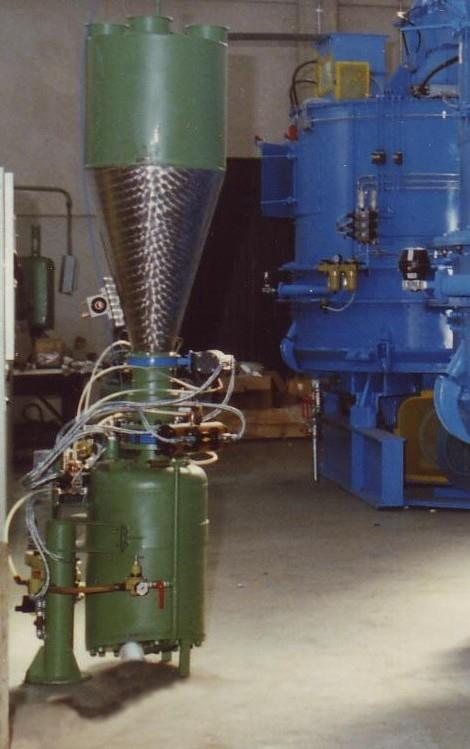
The FONTEC I.P.A. system feeds additives and new sand at low pressure directly into the sand while it is being mixed. The first system dates from 1979, covered by patent no. 1,129,638 in force until 1999. Since then over a hundred systems have been running on various Speedmullor and AER-A-MIX models.
Why
The problem with gravity-fed additives
Many years ago some customers complained that wet dust collectors were drawing off a considerable amount of additives, bentonite in particular, which was then discharged with the excess dirty water because of leaks from the additive feed cup mounted on the cover or on the side of the upper shell.
Fed by gravity, the additives formed small lumps in the sand: cycle after cycle, mud builds up on the damp walls of the mixer and slides into the sand during mulling. The best solution proved to be feeding the additives at low pressure directly into the sand while it is being mixed, highly fluidized at the outlet of the propeller and with a very low density in the air, so that the sand can filter them.
Operation
How it works
An injection lance is fitted tangentially on the outside of the lower shell, at the height of the mulling wheels. From the pressure vessel, connected to the lance by a wear-resistant flexible hose, additives and new sand are injected at low pressure into the sand already being mulled, in the direction of rotation of the crosshead.
Additives and new sand are accurately weighed before injection. The compressed air pressure fed to the propeller is 1 to 1.5 bar.
Advantages
The advantages
- Additives enter the wet sand quickly, already during mixing.
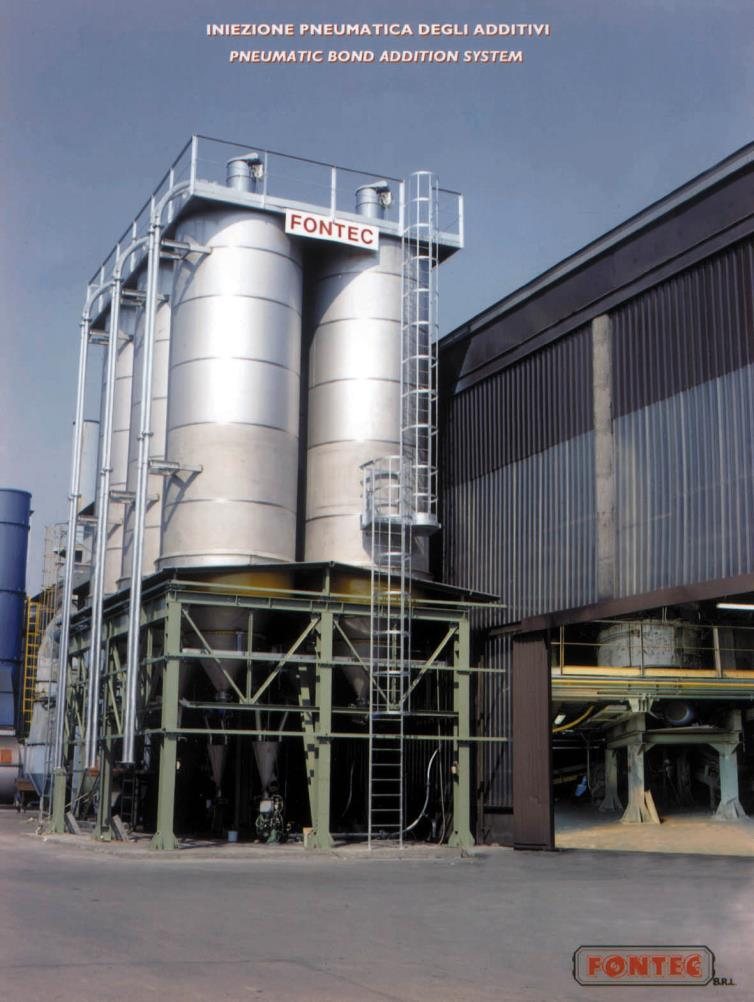
- Storage silos for additives and new sand can be 25 m or more away from the mixer.
- The additive hopper above the mixer is not always dust-tight, and the related pneumatic conveying is eliminated.
- Additives and new sand are premixed before injection, during fluidization.
- Low pressure air is filtered by the wet sand: captured additives are absorbed at once and evenly dispersed, with no sticky mud on walls, cover, crosshead, wheels and plows.
- Fewer additives are used, and maintenance of leaking mechanical devices is reduced.
- Bentonite no longer builds up and saturates the recovery water in wet filters, and fewer additives end up in the dust captured by dry filters.
- Cleaning inside the mixer, often daily because of mud build-up, is needed less often.
- Additives are fully dispersed into the sand without dust forming inside the mixer: only small amounts of sand grains reach the exhaust filters.
- Only a thin layer of mulled sand remains on the inner walls, and it is dispersed in the next cycle instead of forming lumps and casting defects.
- Premixed with the additives, new sand quickly transfers and distributes them into the return sand, giving a flowable, evenly mixed moulding sand that soon reaches its best physical properties.
- According to FONTEC, the total mulling cycle is shortened and the hourly sand output rises by up to 15-20%.
Do you have a plant to serve or a mixer to overhaul?
Tell us about your machine and what you need: the FONTEC technical office answers commercial and technical enquiries.